
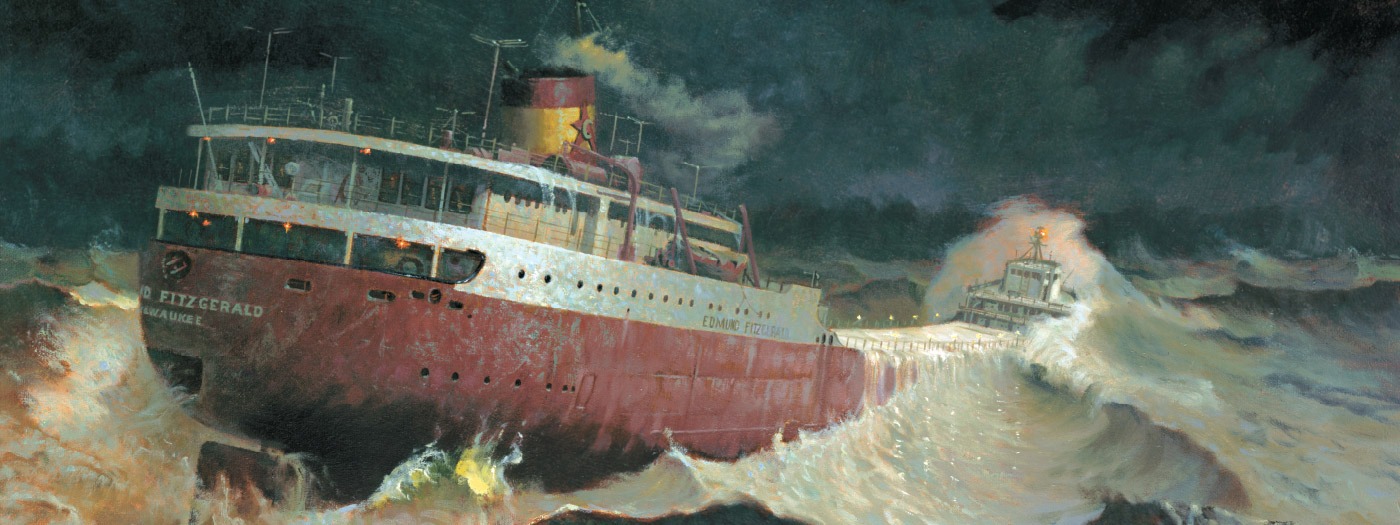
Last Tuesday marked 51 years since the wreck of the Edmund Fitzgerald.
I’ve always felt a fascination with the Fitz. (I’m a native son of Lake Superior’s shores, after all.) There’s something about that “pride of the American side” — a majestic, unsinkable behemoth — slipping beneath the waves without a distress call that is hauntingly-captivating. All these years later, we still talk about how a vessel so magnificent could find itself on Superior’s floor.
This summer, I read John U. Bacon’s excellent book The Gales of November. John has an un-put-down-able way of weaving journalistic research with captivating storytelling. Of particular interest are the interviews conducted with family members, friends, and co-workers of the men on board. One interviewee in particular describes the Fitzgerald‘s Captain Ernest M. McSorely as follows:
“Because Captain McSorely was setting the proper tone for the ship, I didn’t sense any of that negative tension on the Fitzgerald. Everything seemed quite calm, no drama, low key. The Fitz was as good as it gets.”
John summarizes: “Whatever feeling you get, it always starts with the captain. Always.”
In the aftermath of Michigan’s loss to Oregon, Kyle Whittingham bemoaned the fact that fans wanted stability and success in the same year (as if those are mutually-exclusive). In Monday’s press conference, he quipped that “. . . if we wanted to stabilize a program that was in a little bit of disarray and win a championship and all that in the same year, that’s a pretty tough order to accomplish all that.” It was the latest eyebrow-raiser in a season — and presser! — riddled with them.
It got worse. Because later, in an interview with WXYZ in Detroit, Whittingham remarked to Tina Nguyen that “I think we’ve stabilized the program.”
“Whatever feeling you get, it always starts with the captain. Always.”
All in all, Monday saw Michigan’s coach blame the schedule, fan expectations, and the players he inherited. He shrugged off questions about him wandering away from the team during a key timeout, positing that “If we’re 8-2 then that stuff is not a problem.”
At no point does he concede “that stuff” could be the root of the problem.
Leaders “[set] the proper tone.” Losers deflect.
Pointing at all the external factors you can’t control as the reason for failure is the opposite of leadership. It demonstrates just how far underwater Whittingham really is. He’s the captain of the winningest program in college football history. No, he can’t control all the wind and waves that howl around him. But he can “[set] the proper tone.” Take responsibility. Hold people accountable. Be the adult in the room. All the things he was specifically hired to do.
He’s shirked those duties. He’s openly-admitted he doesn’t believe in his own players. He’s defended indefensible coaching decisions, stubbornly refusing to adapt. He’s shown repeated ignorance around the importance of rivalries, asking if there are any trophies left to motivate his players (while losing the only two on the schedule). He has lost the locker room, if he ever had it.
Leaders “[set] the proper tone.” Losers deflect.
Case in point: on Saturday, I watched a furious Rod Moore slam an equipment cart. He walked off the field yelling “I’m done, man!” to fans. I fist-bumped an utterly-dejected Zack Marshall who was infamously suspended for telling the truth about his offensive coordinator (you know, the one who said TEs weren’t relevant in this offense). Meanwhile, Whittingham is jogging off the field with his security, leaving the team behind. An apt metaphor.
You can’t choose the external factors. You can choose how you respond to them. You can choose how you handle yourself, how you inspire those around you, and how you keep them focused and drama-free. Nobody can control the “gales of November.” But you can either be Captain McSorely and “[set] the proper tone” regardless of the result — or you can look at a schedule with ONE ranked away game to date and complain that life’s unfair.
When the gales of November come early, you can either earn respect by leading well, come-what-may — or run the ship aground and blame the crew. Either way, “whatever feeling you get, it always starts with the captain. Always.”
